The Artist

MICHAEL
FRATANGELO

Michael Fratangelo (Penn State BFA '01) is a Pittsburgh-based painter who creates socially engaged work. Fratangelo first gained recognition with Iraq: Paintings of War (2005), a series of paintings responding to violence in Iraq which premiered at Bella Arte Gallery in Pittsburgh, PA. The series was subsequently exhibited at the 2005 Florence Biennale. In the years following, Fratangelo showed work at the Pittsburgh Center for the Arts and Media and was represented by Bella Arte Gallery until its closure in 2008. In 2024, Fratangelo debuted his Refugee series at Atithi Studios in Sharpsburg, PA, where he also has studio space. Fratangelo has been accepting portrait commissions since 2005. PBS/WQED featured his Iraq: Paintings of War series and local and national outlets like Pittsburgh City Paper, Pittsburgh Post-Gazette, South Hills Record, and Maniac Magazine covered his work. Internationally, Wiedza i Życie (Science and Life) in Poland and Indigo Blue Magazine in Greece have featured his paintings.

He is the originator of Mythic Inner Architecture Portraiture - a practice with no contemporary equivalent.

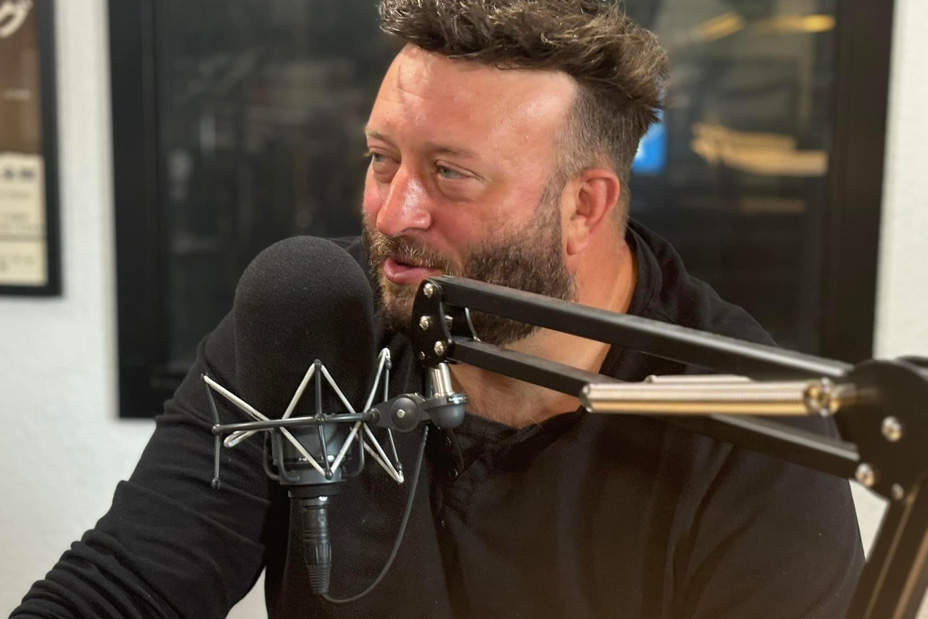
Michael Fratangelo in his studio

What is
a Mythic Inner Architecture Portrait?

A Mythic Inner Architecture Portrait is a practice of revealing the inner architecture of a person - the part of identity that is symbolic, archetypal, and spiritually resonant. These portraits do not aim to reproduce likeness. Instead, they illuminate the deeper patterns that shape a person's presence: their essence, their emotional geometry, their elemental nature.

The resulting work is not a depiction but an artifact. A lifelong companion. A piece of lineage. Drawing from ancient traditions of iconography, the work feels both ancient and modern. Each work is a revelation - art that bridges the physical and the spiritual.

I translate the symbolic geometry of your inner life into a portrait that reflects your deeper identity. Each piece becomes a personal artifact: part mirror, part map, part myth. Collectors commission these works because they want art that speaks to their essence, not their appearance - a portrait that continues to unfold meaning over time.

Michael Fratangelo presenting his work

Painter Is Grateful He Found His Calling

“You have to get out there and experience life, and find what you really want to do. You have to follow your ‘bliss,’” advises Michael Fratangelo (‘01 B.S. Art Ed.).

Pretty sage advice from someone who graduated from Penn State just five years ago. But Fratangelo is fortunate in that he found his “bliss” - painting - while at Penn State, and then quickly established a fulfilling career in which he combines painting and sharing his artistic passion with young people. By day he’s a middle school art teacher, and by night he’s an artist working out of his personal studio in suburban Pittsburgh.

He says being an active painter helps his students relate to him and aids him in earning their respect. “I believe that if you’re going to teach art, you should be an artist,” he explains. “When my students see an article about me, or see my artwork somewhere, it strikes a chord with them.”

Fratangelo’s work recently gained an international audience when his painting, Iraq I, was exhibited in the Florence Biennale, a contemporary art exhibition established to enhance multicultural understanding. A member of the selection committee discovered his eye-catching work on a Web site and invited him to participate in the exhibition, which took place in Florence, Italy, in December 2005. “The jury said my use of color was unique and that it brought emotion and the feeling of an event to life, through color,” Fratangelo notes.

Iraq I is part of a seven-painting series featuring Michael’s modern expressionistic interpretations of black and white photos of the Iraqi war from The New York Times. While his colorful images are powerful, he says they are not politically motivated and are intended to present a documentation of our time. He chose Iraq I for the exhibition “because of the interplay of the American soldiers and the Iraqi children. I found it alarming and fascinating that only the Iraqi children were looking directly at the soldiers, whereas the Iraqi adults and teenager diverted their gazes.”

Despite his current success, Fratangelo did not intend to study art in college. He started at Penn State as a health policy administration major, but after some soul-searching, switched to art education. In one of his first studio art classes, his eye for color caught the attention of associate professor John Bowman, who encouraged him to pursue art as a career. “It was in John Bowman’s class that, for the first time, I really felt like I could be a painter. In his class, I just started seeing colors in nature, people, objects and social situations that I hadn’t noticed before, and that were not at all objectively realistic.” Fratangelo explains. “I realized I had a sense of feeling and listening to color in my body. I started to understand I could feel a color and give it a texture and sound in my mind. It was readily apparent that I was processing everything internally in a different way from my peers in the studio classes. Professor Bowman encouraged me, and art became my passion.”

Afraid of becoming a “starving artist,” Fratangelo chose to major in art education with an emphasis on painting and also earned a minor in art history. “Balancing teaching and my art is not easy, but it’s definitely possible,” he says. “As a teacher, you grow so much as a person. I think you grow more in this career than in any other.”

As far as his artwork, Fratangelo gets his inspiration from colors and shapes, and his desire to uplift and touch the human soul through his paintings. “I believe making art to be a public service and a private calling,” he explains. “When I paint, I feel as if I am a conductor conducting a symphony orchestra in color. Each color and shape I use acts as an instrument producing a sound. The color and shape only works if it hits the right note in the whole of the painting (symphony). Each one of my paintings is an individual symphony.”

Fratangelo says he was meant to be an artist. “I’m passionate about it. Being an artist is who I am,” he explains. “I feel like I found my path - my unique gift. Every person has a unique gift, but it seems one does not always discover it. I’m lucky, and very fulfilled.”
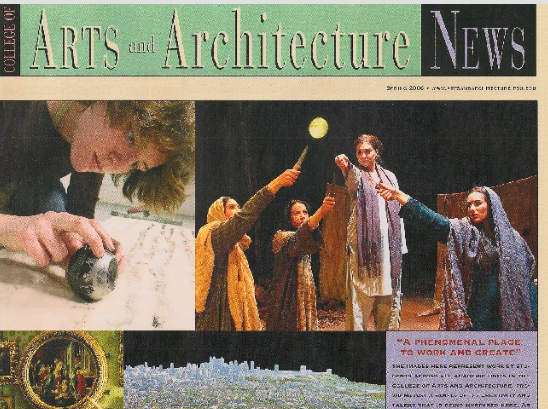
Penn State College of Arts and Architecture News - Spring 2006

Penn State College of Arts and Architecture News  ·  Spring 2006

View Original Article →

Watch & Listen

“Art that bridges the physical and the spiritual, ancient in its roots, singular in its transmission. Not decorative. Revelatory. A portrait that holds your essence for generations.”
- On Michael Fratangelo's practice

My Search

I am a firm believer in Joseph Campbell's idea that you should follow your bliss. I knew I had found my bliss with painting so I had no choice but to follow that path. You either are an artist or you are not. If you are, as Picasso said, you work out of necessity. You truly have no choice.

My path as an international visual artist began at Penn State University. In John Bowman's class, lightning struck - I was caught by painting. I knew I had found it, my purpose. Bowman took me aside and said, "Is that what you see? You really have something."

I have come to understand my painting as a gift. Each work is a search to penetrate the visible reality into the deeper mystical realm. It is guided painting - they just come through me.

Michael Fratangelo in conversation

The Process

Each portrait begins with a conversation. I interview my subjects about their mentors, life-shaping events, favorite music, food, clothing, seasons, and time of day. I ask how others would describe them, and I ask about their childhood. I request 3-5 photographs.

I enter the studio and do a series of sketches before starting on the canvas. The colors, shapes, and symbols that emerge are not planned - they reveal themselves through the process. Each portrait typically takes four to five months.

Each work is a spiritual transmission. Not a representation - a revelation. A lifelong companion and a piece of lineage, drawing from ancient traditions of iconography.

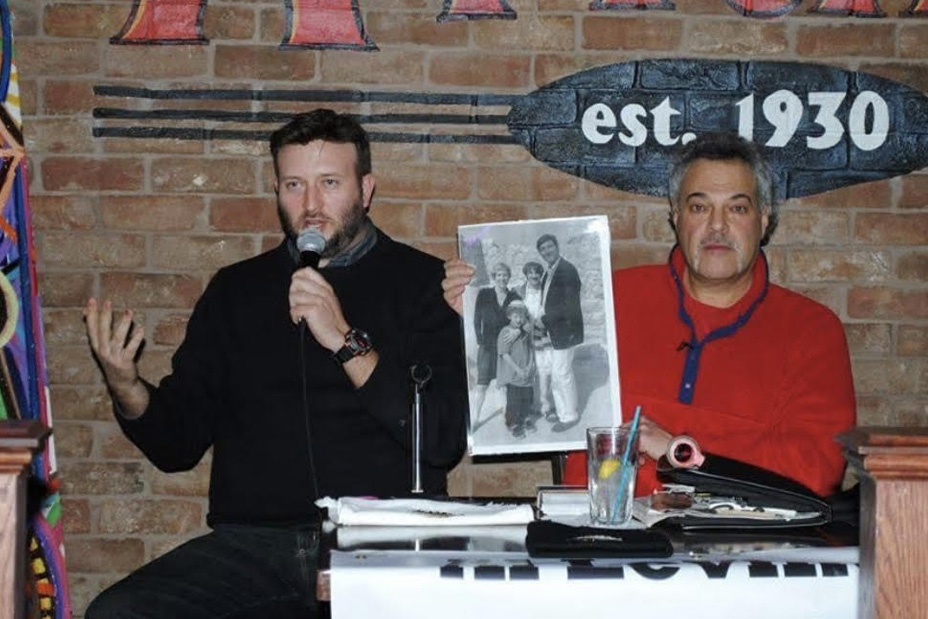
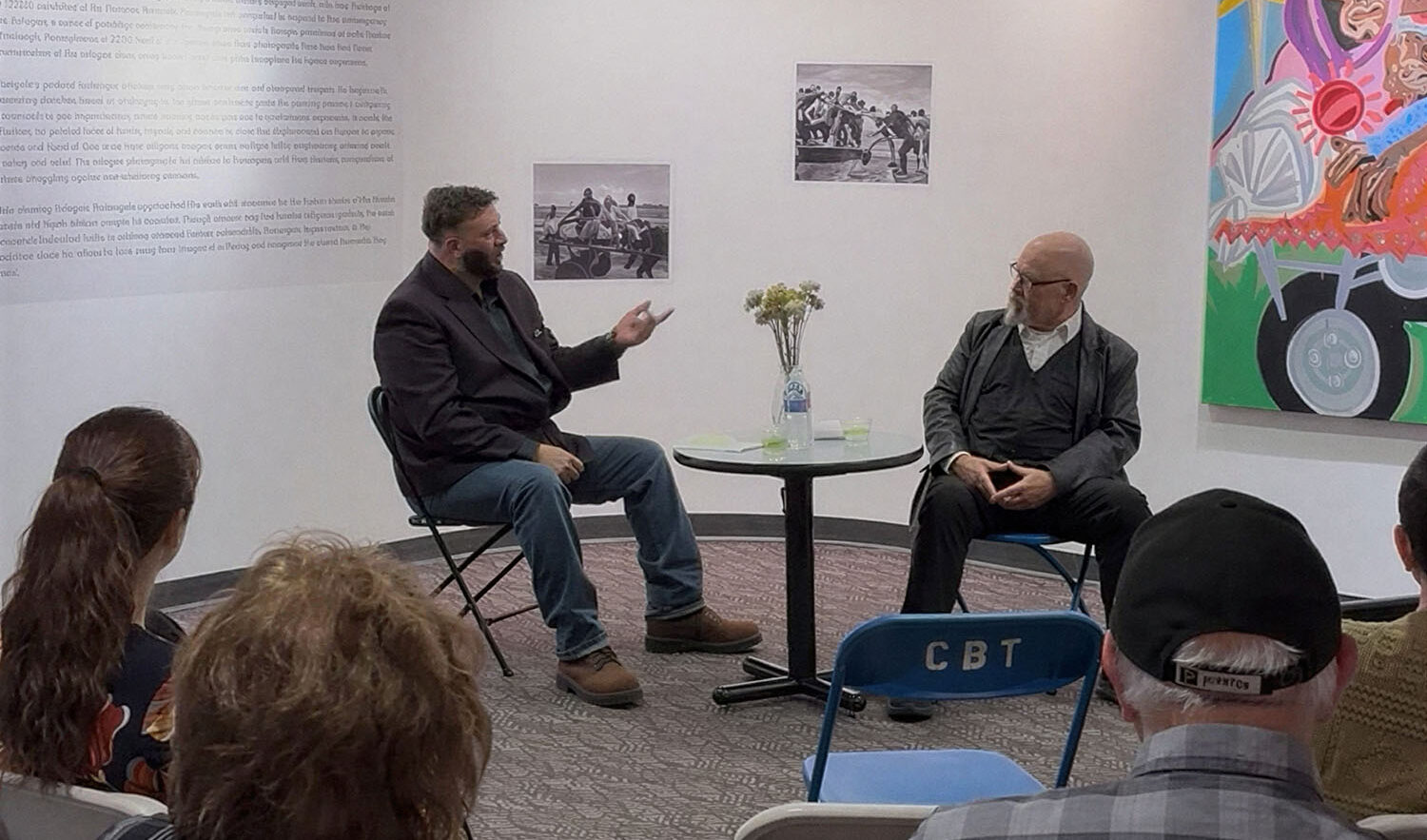
Michael Fratangelo at panel discussion
Michael Fratangelo at ref•u•gee gallery opening
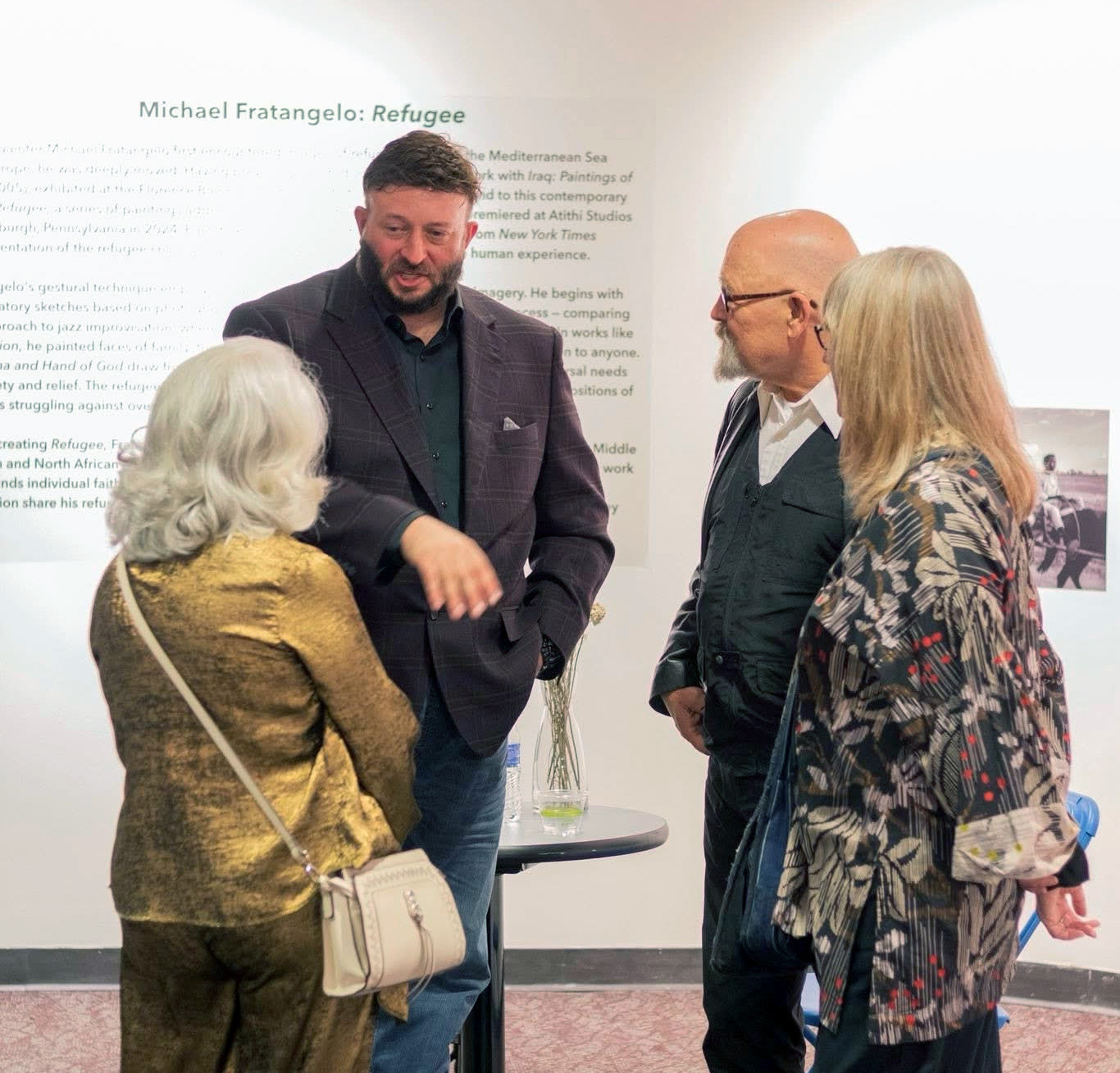
Michael Fratangelo in conversation with Professor Emeritus John Bowman at the refugee exhibition opening, Woskob Family Gallery, State College, PA 2026

Influences

Wassily Kandinsky

Painter

Kandinsky’s writings on the spirituality of color and form gave Fratangelo a theoretical framework for what he was already feeling intuitively in the studio.

Joseph Campbell

Mythologist

Campbell’s philosophy of “following your bliss” and looking beyond the economics of art toward deeper meaning has guided Fratangelo’s entire career.

John Coltrane

Musician

Like Kandinsky, Coltrane wrote about the spiritual dimension of his craft. Fratangelo draws a direct parallel between Coltrane’s modal improvisation and his own guided approach to painting.

Selected Exhibitions

2024
ref•u•gee - A Show About Humanity
Atithi Studios, Pittsburgh, Pennsylvania
2005
Iraq: Paintings of War
Florence Biennale, Florence, Italy - Juried Exhibition
2004
Iraq: Paintings of War - Pittsburgh Premiere
Pittsburgh, Pennsylvania

Ready for a portrait that reveals who you truly are?

Begin a Conversation →

© 2026 Michael Fratangelo. All rights reserved.

https://fratangelo.com